Dr.
Group will lead discussion on extreme weather preparedness and community resilience at AGU Annual Meeting
Fri, 08/07/2026 - 12:26pmThe American Geophysical Union (AGU) will hold its annual meeting, which is the largest gathering of Earth and space scientists, from December 7-11, 2026, in San Francisco, CA. This event will bring together over 25,000 attendees from more than 100 countries to share research, connect, collaborate, and inspire one another.
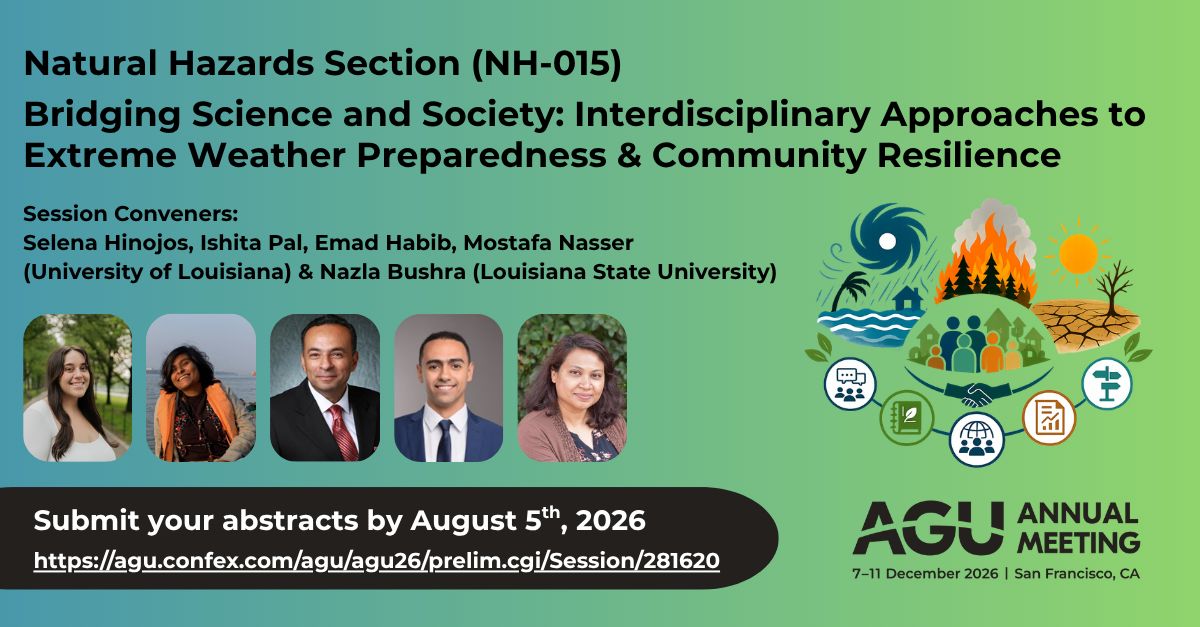
We are excited to lead a session at #AGU26 on Natural Hazards: (NH015) Bridging Science and Society - Interdisciplinary Approaches to Extreme Weather Preparedness and Community Resilience.
Session Conveners: Selena Hinojos, PhD, Ishita Pal, PhD, Emad Habib, Mostafa Nasser (UL Lafayette) & Nazla Bushra (Louisiana State University)
The session highlights work that bridges water-, wind-, and fire-based natural hazards with community-level preparedness and resilience, supported by community co-creation, Indigenous and local knowledge, historical analysis, risk communication, and/or decision-support frameworks. Special interest in work that translates scientific findings into actionable outcomes for underserved and frontline communities.
Session Abstract: Extreme weather events, like floods, hurricanes, wildfires, and droughts, increasingly challenge communities' adaptive capacity, particularly in climate-vulnerable regions. While significant advances have been made in physical hazard science, translating these insights into community-level preparedness and resilience remains constrained by disciplinary silos. This session aims to bridge natural hazards sciences with social, historical, and policy perspectives on managing extreme weather events and invites contributions that advance integrated approaches to hazard preparedness and resilience. We welcome abstracts that address water-, wind-, and fire-based extremes, and that incorporate community co-creation, Indigenous and local knowledge, historical analysis, risk communication, and/or decision-support frameworks. Special interest is given to work that connects scientific findings to actionable outcomes for underserved and frontline communities. This session builds on the growing momentum at the intersection of climate-driven extreme events and community resilience, encouraging cross-disciplinary dialogue to support equitable and evidence-based adaptation strategies.